APSA Training Course – Securitisation: The Practitioner’s Playbook

Course Summary

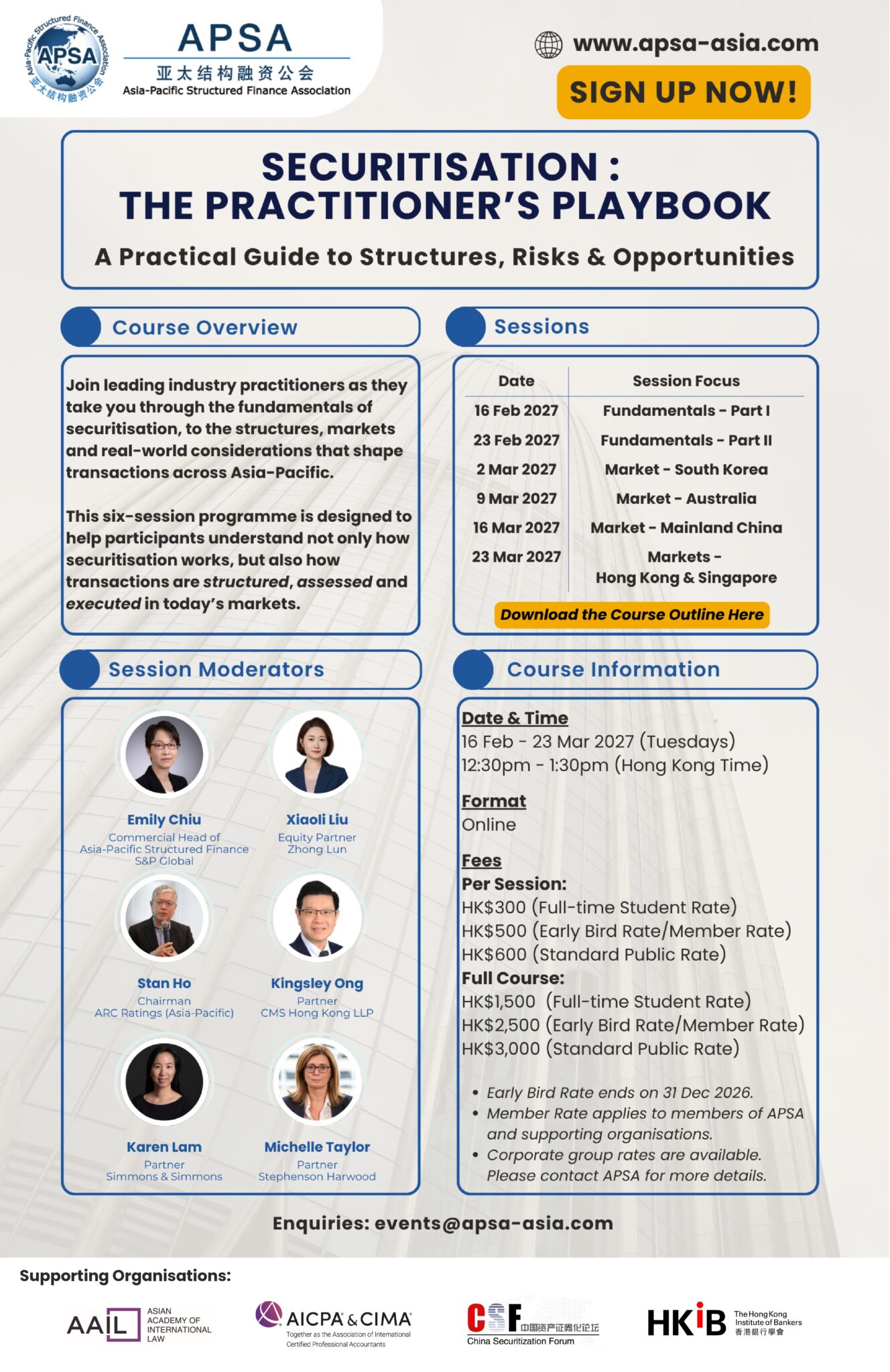
Join leading industry practitioners as they take you through the fundamentals of securitisation, to the structures, markets and real-world considerations that shape transactions across Asia-Pacific.

This six-session programme is designed to help participants understand not only how securitisation works, but also how transactions are structured, assessed and executed in today’s markets.

Session 1: Fundamentals Part I

16 February 2027 | 12:30 – 1:30pm (Hong Kong Time)

This session introduces the historical context and evolution of securitisation, including its key terminology, benefits and risks, and the use of special purpose vehicles. It explains the accounting and legal principles underpinning derecognition and off-balance-sheet treatment, and true sale and bankruptcy remoteness, while also outlining the practical roles of lawyers, accountants, trustees and paying agents, in securitisation transactions.

Session 2: Fundamentals Part II

23 February 2027 | 12:30 – 1:30pm (Hong Kong Time)

This session builds on the basics covered in Part 1 and introduces the principal asset-backed securities (ABS) products, including asset-backed securities (ABS), residential mortgage-backed securities (RMBS), commercial mortgage-backed securities (CMBS), and collateralised debt obligations (CDOs). It outlines the roles of arrangers, issuers, investors and rating agencies in securitisation transactions. Participants will also examine sequential and pro-rata payment structures, as well as common credit-enhancement tools such as over-collateralisation, subordination and external guarantees.

Session 3: South Korea

02 March 2027 | 12:30 – 1:30pm (Hong Kong Time)

This session introduces the development and distinctive features of Korea’s securitisation market, including the legal and structural considerations that shape Korean asset-backed securities transactions. It explains the typical transaction process and the use of two special purpose vehicles (SPVs), including the rationale for this structure. The session will examine selected asset classes, including credit-card receivables, auto-related assets and future-flow transactions, together with the use of term-and condition swaps and other practical structuring considerations relevant to the Korean market.

Session 4: Australia

09 March 2027 | 12:30 – 1:30pm (Hong Kong Time)

This session examines the development and evolution of Australia’s securitisation market, including the transaction structures and market practices that have supported its growth and resilience. It considers residential mortgage-backed securities, the largest segment of the Australian market, alongside other forms of asset-backed securities and the underlying asset classes represented in the market. Participants will gain an overview of how investors and rating agencies assess Australian securitisation transactions, and how Australian market practices compare with those in other global securitisation markets.

Session 5: Mainland China

16 March 2027 | 12:30 – 1:30pm (Hong Kong Time)

This session introduces the development of Mainland China’s securitisation market and the principal issuance schemes available across the interbank bonds market, exchange market and asset-backed notes market, as well as trust and insurance asset-management structures. It explains how these frameworks differ in regulations, approval processes and transaction structures, while sharing many of the core principles of global SPV securitisation structures. The session will cover representative asset classes, including consumer loans, auto leases and equipment leases ABS, together with major approval, currency and cross-border considerations, recent market innovations and China’s developing links with Hong Kong as a financing hub.

Session 6: Hong Kong & Singapore

23 March 2027 | 12:30 – 1:30pm (Hong Kong Time)

This session examines the securitisation process and transaction structures used in the common-law markets of Hong Kong and Singapore. It covers selected products and asset classes, including CDOs involving project-finance assets, CMBS and covered bonds. The session also explains key tax considerations for originators, issuers and investors, including the importance of tax neutrality and its impact on the feasibility and structuring of a transaction.

Supporting Organisations

Course Flyer

Please refer to the Terms & Conditions for further details.